During shell-and-tube heat exchanger maintenance, removing a tube bundle changes the way its weight is supported. As the bundle moves out of the shell, the extraction equipment progressively takes over the load. During reinstallation, this process is reversed.
A successful extraction arrangement must therefore do more than generate sufficient pulling force. It must maintain the intended direction of movement, support the bundle through each stage of travel and provide a controlled transfer to the next handling operation.
For maintenance engineers and equipment buyers, three questions are particularly important: Is the bundle puller correctly aligned? How will the load be supported during movement? Does the proposed equipment configuration match the exchanger and site?
Axial Alignment Controls the Direction of Extraction
A bundle extractor should be positioned so that its intended extraction path follows the heat exchanger’s bundle-removal axis.
Alignment needs to be checked in both the horizontal and vertical planes. The pulling attachment must also be compatible with the exchanger’s approved attachment points and the equipment manufacturer’s connection arrangement.
An offset between the pulling direction and the intended extraction axis can introduce an unwanted lateral force or moment. This may increase contact between the bundle and shell, create uneven loading at the connection or make movement more difficult.
The relevant checks include:
- The extractor’s position relative to the exchanger centerline.
- The height and orientation of the pulling connection.
- Clearance between the moving bundle and surrounding components.
- The stability of the equipment in its working position.
- The alignment adjustments permitted by the supplied configuration.
Alignment should be observed throughout the operation. A satisfactory starting position does not guarantee that the arrangement will remain correct as the bundle moves and the load distribution changes.
Load Transfer Must Be Considered Throughout the Travel
Before extraction, the bundle is supported within the exchanger according to its construction. As removal proceeds, support transfers to the extraction and handling arrangement.
This transfer is continuous. Checking only the fully extracted bundle weight does not establish that every intermediate position is acceptable.
The equipment arrangement should be reviewed for the complete movement sequence:
| Operating stage | Engineering consideration |
|---|---|
| Initial release | Pulling connection, axial alignment and resistance to initial movement |
| Partial extraction | Changing load distribution and engagement of the planned supports |
| Full extraction | Support of the complete bundle within the approved equipment configuration |
| Transfer | Controlled handover to lifting equipment, transport equipment or prepared storage supports |
The bundle’s center of gravity and the positions of its supports affect the reactions carried by the equipment. These conditions may change as the bundle advances.
For this reason, equipment selection should consider the proposed support geometry as well as the total bundle weight.
Support Locations Must Suit the Bundle Construction
A tube bundle is an assembly of tubes, tubesheets, baffles and other components. It should not be treated as a solid load that can be supported at any convenient location.
Support positions must be selected with reference to the bundle drawing, its construction and the approved handling instructions. Contact with exposed tubes or other vulnerable components can cause localized damage.
Where support trolleys or cradles are used, their rated capacity, contact arrangement and permitted movement must be suitable for the intended duty. Load sharing between several supports should be assessed; it should not be assumed that each support carries an equal proportion of the weight.
The extraction plan should define when each support becomes effective and how the bundle will remain supported during the next stage of movement.
Initial Release and Continued Movement Are Different Conditions
The force required to start a bundle moving may differ from the force required to continue extraction.
Fouling, corrosion products, mechanical interference or distortion can contribute to resistance. An abnormal increase in resistance may also indicate an alignment or support problem.
The equipment’s maximum pulling-force rating does not establish an acceptable force for every exchanger. The pulling attachments, connection points and exchanger components must also be suitable for the proposed loading.
If movement stops or becomes uneven, the cause should be investigated before continuing. Increasing hydraulic pressure alone does not resolve a mechanical obstruction or an unsuitable support arrangement.
Operating limits and stop criteria should follow the equipment instructions and the approved job-specific procedure.
Match Usable Length and Clearance to the Actual Assembly
Nominal bundle length is only one of the dimensions required for equipment matching.
The review should distinguish between:
- Bundle overall length: the actual assembly length relevant to removal and handling.
- Usable extraction length: the working length available in the proposed equipment configuration.
- Equipment overall dimensions: the space occupied by the complete machine.
- Site working clearance: the space needed for positioning, movement, access and transfer.
Maximum external dimensions should also include relevant tubesheet features, projections and attachments. The nominal tube bundle diameter alone may not describe the full clearance requirement.
Any extension or alternative frame arrangement must be assessed as part of the complete configuration. Added length does not automatically provide the same permitted loading or support conditions at every position.
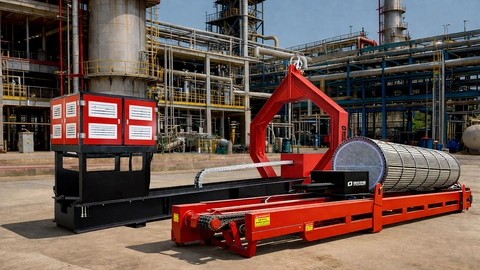
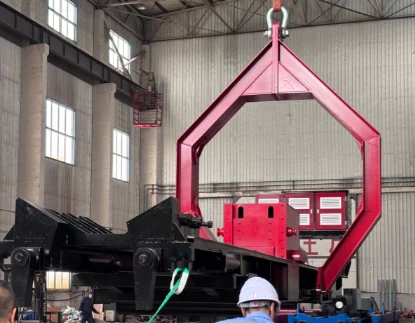
Jingchen’s diesel bundle puller technical specifications provide reference dimensions and capacities for preliminary comparison. Final matching should use the proposed configuration and the actual exchanger information.
Select the Power Source Separately from the Handling Arrangement
Diesel and electric drive systems provide different options for site power, but neither replaces the need to check alignment, load transfer and structural compatibility.
For an electric bundle extractor, the available voltage, frequency and electrical supply capacity need to match the supplied equipment. Cable routing must accommodate the planned movement and site access.
For a diesel bundle puller, the project should address ventilation, exhaust routing, fuel handling and applicable site restrictions.
Where the work area has hazardous-area requirements, the suitability of the complete supplied configuration must be verified against the site classification. Drive type alone does not establish compliance.
The electric bundle extractor range can be reviewed alongside the site power requirements when comparing equipment options.
Include Reinstallation in the Handling Plan
The extraction arrangement should be developed with reinstallation in mind.
After maintenance, the bundle must be presented to the shell at the required height, orientation and alignment. The supports need to accommodate controlled insertion as the load transfers back into the exchanger.
The plan should also address intermediate storage and transfer. A bundle placed on unsuitable supports after removal may be difficult to reposition or may suffer damage before reinstallation begins.
Recording orientation and relevant positioning details during removal can assist the subsequent reassembly process. Final insertion and assembly must follow the exchanger manufacturer’s requirements and the approved maintenance procedure.
Information Required for Equipment Review
A technically useful enquiry should include the exchanger drawing, bundle weight and dimensions, centerline elevation, site photographs and any known extraction difficulties.
The proposed equipment can then be reviewed for pulling force, load capacity, usable length, support arrangement and access requirements as a complete system.
Equipment condition also matters. Hydraulic components, pulling attachments, supports and control functions should be inspected in accordance with the manufacturer’s instructions before deployment. Further information is available through Jingchen’s bundle extractor maintenance support.
Jingchen Petroleum Equipment supplies diesel and electric tube bundle extractors for heat exchanger maintenance. Provide your exchanger and site information to request a quote and discuss a configuration suited to the planned extraction and reinstallation work.